AdSense Header Bidding: Complete Guide for Publishers in 2024
Master AdSense header bidding implementation, optimization strategies, and revenue maximization. Expert guide for publishers and ad ops professionals.
What is AdSense Header Bidding?
Header bidding has revolutionized programmatic advertising by enabling publishers to offer their ad inventory to multiple demand sources simultaneously before calling their ad server. Google AdSense header bidding, specifically through Google Ad Exchange (AdX), represents one of the most significant revenue opportunities for qualified publishers.
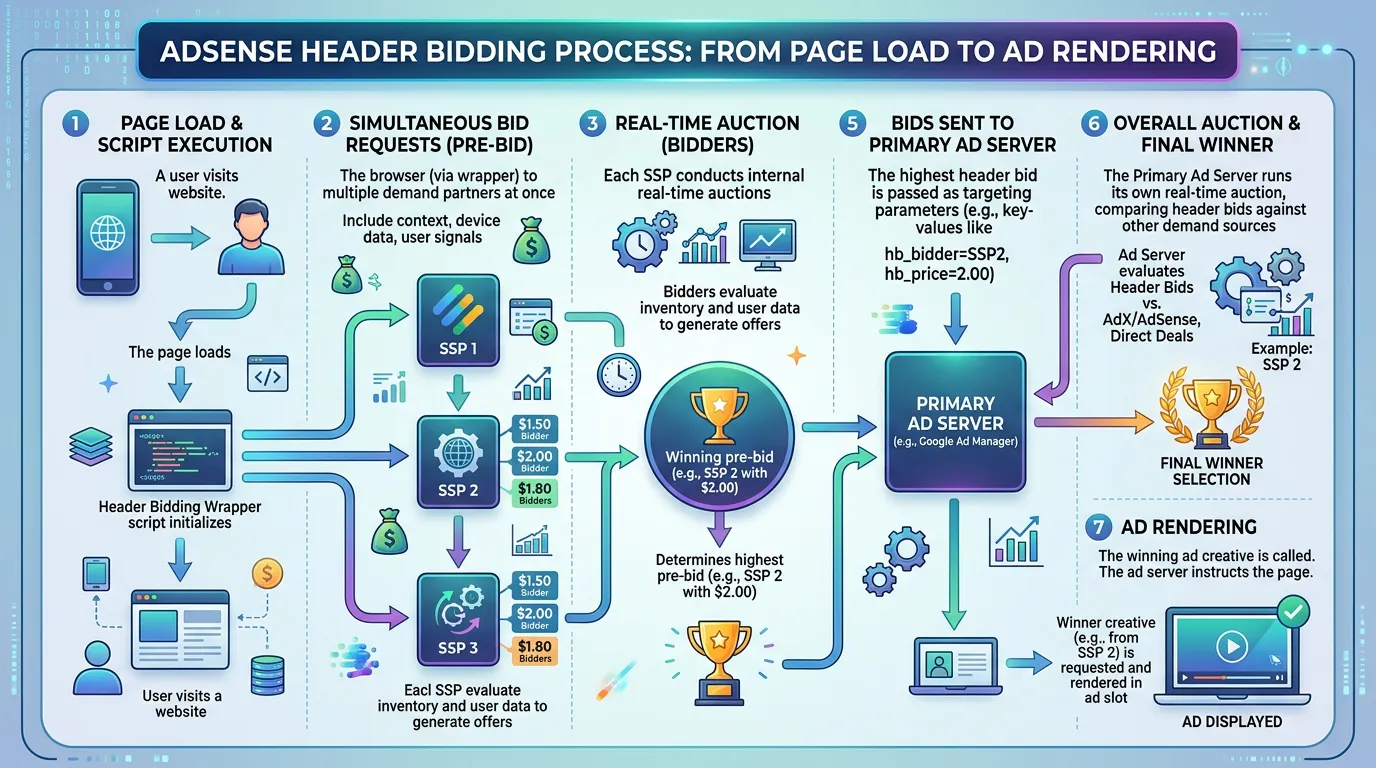
Unlike traditional waterfall setups where ad requests are made sequentially, header bidding allows demand partners to compete in real-time auctions directly in the user's browser. This creates a truly competitive environment where the highest bidder wins, regardless of their position in the traditional ad server hierarchy.
How AdSense Header Bidding Works
The Technical Process
When a user visits a webpage with header bidding implemented, several crucial steps occur within milliseconds:
- Page Load Initiation: The browser begins loading the webpage and encounters the header bidding wrapper code
- Simultaneous Bid Requests: Multiple demand partners, including AdX, receive bid requests simultaneously
- Real-Time Auction: Each partner evaluates the impression and submits their highest bid
- Bid Collection: The wrapper collects all bids within a predefined timeout period (typically 1-2 seconds)
- Winner Selection: The highest bid is passed to the ad server as a line item
- Final Competition: The ad server runs its own auction between the header bidding winner and any direct-sold campaigns
- Ad Rendering: The winning creative is displayed to the user
AdSense Integration Specifics
Google's approach to header bidding differs from other demand partners due to their unique position in the ecosystem. AdSense publishers can access header bidding through:
- Google Ad Manager Integration: Direct integration through GAM's unified auction
- Third-Party Wrappers: Implementation via Prebid.js or other header bidding solutions
- Server-Side Solutions: Google's Open Bidding (formerly Exchange Bidding in Dynamic Allocation)
Benefits of AdSense Header Bidding
Revenue Optimization
The primary advantage of implementing AdSense header bidding is significant revenue uplift. Publishers typically see:
- 15-30% increase in CPMs: Real-time competition drives higher bid prices
- Improved fill rates: Multiple demand sources reduce unfilled impressions
- Better yield optimization: True price discovery ensures maximum revenue per impression
Enhanced Control and Transparency
Header bidding provides publishers with unprecedented visibility into their programmatic revenue:
- Bid-level reporting: See exactly what each partner is bidding
- Timeout optimization: Control auction duration to balance revenue and latency
- A/B testing capabilities: Compare performance across different configurations
Reduced Latency Impact
Modern header bidding implementations have addressed early concerns about page load speed:
- Asynchronous loading: Ads don't block page content rendering
- Intelligent timeouts: Automatic optimization based on historical performance
- Server-side options: Move auction logic to reduce browser processing
Implementation Strategies
Prebid.js Integration
Prebid.js remains the most popular open-source header bidding wrapper. For AdSense integration:
pbjs.addAdUnits([{
  code: 'div-banner-ad',
  mediaTypes: {
    banner: {
      sizes: [[728, 90], [970, 250]]
    }
  },
  bids: [{
    bidder: 'appnexus',
    params: {
      placementId: 13144370
    }
  }, {
    bidder: 'rubicon',
    params: {
      accountId: 14062,
      siteId: 70608,
      zoneId: 498816
    }
  }]
}]);
Google Ad Manager Setup
Proper GAM configuration is crucial for AdSense header bidding success:
- Create Price Priority Line Items: Set up line items at various price points ($0.10, $0.50, $1.00, etc.)
- Configure Key-Value Targeting: Use hb_pb (price bucket) targeting for bid selection
- Set Up Creative Templates: Implement universal creative code for winner rendering
- Enable Unified Pricing Rules: Ensure consistent auction dynamics
Server-Side Implementation
For publishers with significant scale, server-side header bidding offers advantages:
- Reduced browser overhead: Auction processing moved to servers
- Improved user experience: Faster page loads with maintained revenue
- Enhanced targeting: Access to server-side data for better bid optimization
Google's Open Bidding provides a server-side solution that integrates seamlessly with AdSense:
googletag.cmd.push(function() {
  googletag.pubads().enableSingleRequest();
  googletag.pubads().setTargeting('test_key', 'test_value');
  googletag.enableServices();
});
Optimization Best Practices
Timeout Management
Balancing revenue and user experience requires careful timeout optimization:
- Start Conservative: Begin with 1000ms timeouts and adjust based on performance
- Monitor Bid Response Times: Identify slow partners and adjust accordingly
- Implement Dynamic Timeouts: Use different timeouts for different ad sizes or positions
- Consider Connection Speed: Adjust timeouts based on user's network conditions
Price Granularity
Optimizing price buckets ensures maximum revenue capture:
pbjs.setConfig({
  priceGranularity: {
    'buckets': [{
      'precision': 2,
      'min': 0,
      'max': 5,
      'increment': 0.01
    }, {
      'precision': 2,
      'min': 5,
      'max': 10,
      'increment': 0.05
    }, {
      'precision': 2,
      'min': 10,
      'max': 50,
      'increment': 0.10
    }]
  }
});
Partner Selection and Management
Successful header bidding requires strategic demand partner selection:
- Quality over Quantity: 8-12 quality partners often outperform 20+ mediocre ones
- Geographic Relevance: Ensure partners have strong demand for your audience
- Regular Performance Reviews: Monthly analysis of partner contribution and optimization
- Brand Safety Considerations: Implement proper filtering and blocking controls
Video Header Bidding with AdSense
Video inventory represents the highest-value opportunity for most publishers. AdSense header bidding for video requires specialized implementation:
VAST Integration
Video ads require VAST-compliant delivery:
const videoAdUnit = {
  code: 'video1',
  mediaTypes: {
    video: {
      context: 'instream',
      playerSize: [640, 480],
      mimes: ['video/mp4'],
      protocols: [1, 2, 3, 4, 5, 6, 7, 8],
      playbackmethod: [2],
      skip: 1
    }
  },
  bids: [{
    bidder: 'appnexus',
    params: {
      placementId: 13232361,
      video: {
        skippable: true,
        playback_method: ['auto_play_sound_off']
      }
    }
  }]
};
Video Player Integration
Modern video players must support header bidding integration. Publishers using solutions like Veedmo can benefit from built-in header bidding support that streamlines the implementation process and ensures optimal video ad monetization across multiple demand sources.
Common Implementation Challenges
Latency Management
Header bidding can impact page load speed if not properly implemented:
Solution: Implement asynchronous loading and optimize timeout settings
pbjs.que.push(function() {
  pbjs.requestBids({
    timeout: 1000,
    bidsBackHandler: function() {
      googletag.cmd.push(function() {
        pbjs.setTargetingForGPTAsync();
        googletag.pubads().refresh();
      });
    }
  });
});
Discrepancy Management
Revenue discrepancies between header bidding and ad server reporting are common:
Causes:
- Different counting methodologies
- Viewability requirements
- Ad blocking software
- Network timeouts
Solutions:
- Implement consistent measurement standards
- Use bid landscape analysis
- Regular reconciliation processes
- Viewability optimization
AdSense Policy Compliance
Maintaining AdSense compliance while implementing header bidding requires attention to:
- Content Policy Adherence: Ensure all demand sources follow Google's content guidelines
- Traffic Quality: Implement proper bot filtering and invalid traffic detection
- User Experience Standards: Maintain acceptable ad density and placement practices
- Data Privacy Compliance: Proper GDPR and CCPA implementation across all partners
Performance Monitoring and Analytics
Key Performance Indicators
Monitor these critical metrics for header bidding success:
-
Revenue Metrics:
- Total revenue uplift
- CPM improvement by ad unit
- Fill rate optimization
- Partner contribution analysis
-
Technical Metrics:
- Timeout rates by partner
- Bid response times
- Error rates and debugging
- Page load impact measurement
-
User Experience Metrics:
- Page speed impact
- Viewability rates
- Ad blocking detection
- User engagement correlation
Reporting and Optimization
Implement comprehensive reporting for ongoing optimization:
pbjs.onEvent('bidWon', function(bid) {
  analytics.track('Header Bidding Win', {
    bidder: bid.bidder,
    cpm: bid.cpm,
    adUnitCode: bid.adUnitCode,
    timeToRespond: bid.timeToRespond
  });
});
Future of AdSense Header Bidding
Privacy-First Advertising
The evolving privacy landscape affects header bidding implementation:
- Cookieless Solutions: Preparing for third-party cookie deprecation
- First-Party Data Activation: Leveraging publisher data for better targeting
- Privacy Sandbox Integration: Adapting to Google's privacy-preserving technologies
Advanced Optimization Techniques
Emerging trends in header bidding optimization:
- Machine Learning Integration: AI-powered timeout and partner optimization
- Real-Time Bidding Intelligence: Dynamic floor pricing and partner selection
- Cross-Device Optimization: Unified auction strategies across platforms
Conclusion
AdSense header bidding represents a critical revenue optimization opportunity for qualified publishers. Success requires careful implementation, ongoing optimization, and attention to both technical performance and user experience. Publishers who invest in proper setup and continuous monitoring typically see significant revenue improvements while maintaining site performance.
The key to success lies in balancing competition intensity with technical performance, ensuring compliance with AdSense policies, and continuously optimizing based on data-driven insights. As the programmatic landscape continues to evolve, publishers who master header bidding implementation will be best positioned to maximize their advertising revenue in an increasingly competitive environment.
Frequently asked questions
What is the difference between AdSense header bidding and traditional ad serving?
Traditional ad serving uses a waterfall approach where ad requests are made sequentially to different partners. Header bidding allows multiple demand sources, including AdSense/AdX, to bid simultaneously in real-time, creating true competition and typically resulting in 15-30% higher CPMs.
How long does it take to implement AdSense header bidding?
Basic implementation typically takes 2-4 weeks for experienced developers, including setup, testing, and optimization. This includes Prebid.js integration, Google Ad Manager configuration, and initial partner onboarding. Complex implementations with custom solutions may take 6-8 weeks.
Will header bidding slow down my website?
When properly implemented with optimized timeouts (1000-1500ms) and asynchronous loading, header bidding should have minimal impact on page speed. Modern implementations can actually improve user experience by reducing unfilled ad slots and improving overall monetization.
What are the minimum requirements for AdSense header bidding?
Publishers need Google Ad Manager access (typically requiring significant traffic), technical development resources, and compliance with AdSense policies. Most successful implementations require at least 1 million monthly pageviews and dedicated ad ops management.
How do I measure the success of my header bidding implementation?
Key metrics include total revenue uplift (typically 15-30%), CPM improvements, fill rate optimization, partner win rates, timeout performance, and page latency impact. Implement comprehensive analytics to track bid-level data and user experience metrics.